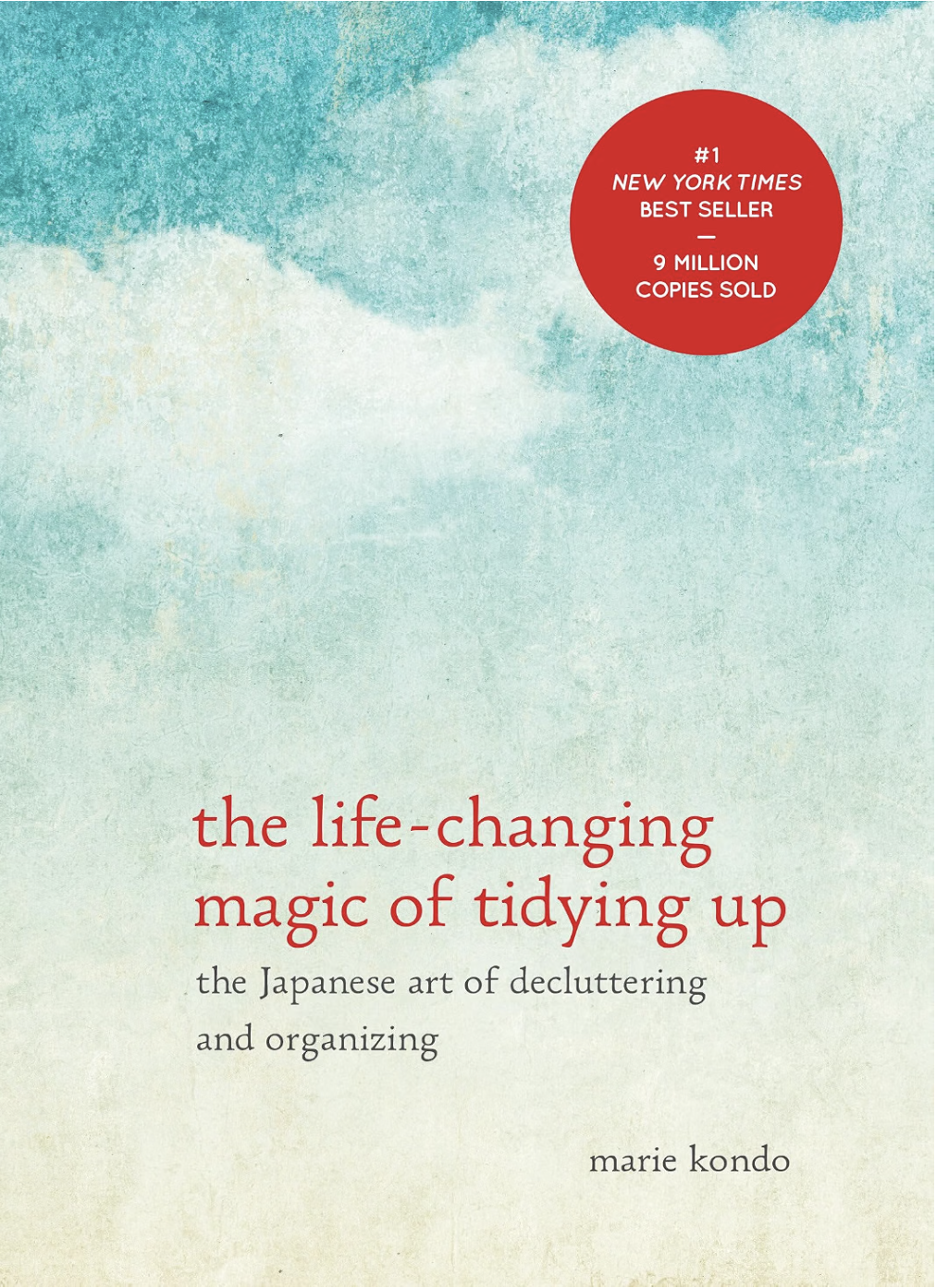
I'm in the middle of reading Marie Kondo's The Life-Changing Magic of Tidying Up, and one idea keeps following me from room to room:
When something no longer brings you joy, you don't just toss it. You thank it for the job it did, and you let it go gracefully.
I love that, it made my heart flutter to read that over in my mind. It turns decluttering from a chore into a small act of gratitude, and the shift isn't only on your shelves. It happens in you, too. (I have a feeling this book will show up here again as I keep reading and applying.)
As someone with great disdain for clutter and mess- please consider this post a little tough love, served warm…
Everything that takes up space in your home should earn its spot. It should be useful, intentional or bring you joy. If it isn't doing any of those things, it might be time to say thank you and goodbye.
Disclaimer: As an Amazon Associate, I earn from qualifying purchases.
What does a professional organizer throw away?
Here's the short answer: I throw away anything that has already done its job, anything I'm saving for a "someday" that isn't coming, and any paper I'm no longer required to keep. Gifts I don't use. Manuals I can find online. The lamp I've been "meaning to fix" since spring. Junk mail, before it ever hits the counter.
Once I decide to let something go, I let it go. And I don't feel guilty about it.
That's not because I'm cold. After extensive years of sorting, scanning and filing other people's things AND my own- I've learned that guilt is a terrible filing system. It keeps things in your home that you don't want, don't use and don't love, and it charges rent in space, time and stress. Holding on to things that no longer serve you can quietly drain your energy, too, and that weight shows up in the rest of your life.
One quick note before the list: I'm not a "toss everything" person. Broken things that still hold real value to me, whether sentimental or financial, get their own plan. More on that in #6.
Below are the 12 things I let go of without a second thought, the guilt that usually keeps them around, and the one thought that makes it easier to let go.
Why is it sooo hard to throw things away?
Most clutter isn't about the item. It's about the feeling, emotion and story attached to it. In my line of work, that guilt usually shows up in one of four ways:
Money guilt: "I paid good money for that."
Giver guilt: "Someone I love gave me that."
Someday guilt: "I might need it someday."
Waste guilt: "It's still perfectly good."
Every one of those feelings makes sense. None of them is a reason to keep something. Once you name the one you're feeling, the decision gets so much easier.
The 12 things I throw away without guilt
I've grouped them by the reason each one is easy to let go.
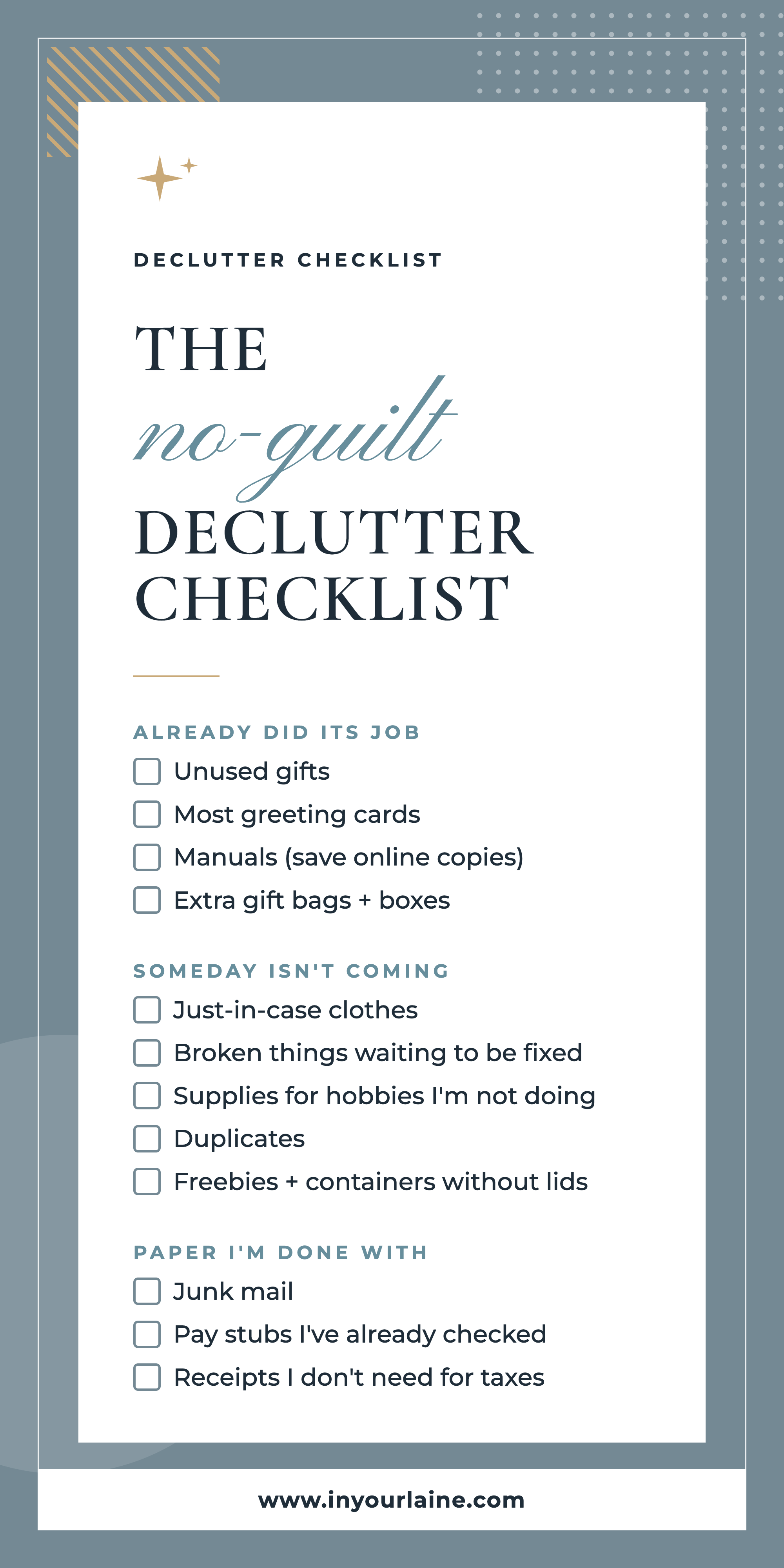
Things that already did their job1. Gifts I don't use. A gift's job is to say "I thought of you," and it did that the moment I opened it. Keeping it in a closet doesn't make the gesture mean more. Honestly, the person who gave it would rather it get used than gather dust. If it doesn't fit my life, I keep the thank-you and pass the thing along to someone who'll love it.
2. Most greeting cards. I keep the few that make me tear up. The rest get a read, a photo if the message really matters, and then they go. A card's job is the moment you read it. If you are the crafty and creative kind- reuse greeting cards to create a scrapbook of sorts!
3. Manuals for things I own. I went through a box full of manuals for items that I no longer owned and tossed out. Most manuals live online now. Before I toss one, I make sure it's on the manufacturer's website, then I save the link in a "Home Manuals" folder in my cloud drive and on my desktop. Warranty info and receipts for big purchases get filed. The 80-page booklet in six languages? Toss!
4. The "good" boxes and gift bags. I'll admit I’m a bit biased on this one, because I'm a sucker for pretty packaging. Were you also ever obsessed over those cute decorative storage boxes at Marshalls, TJ Maxx and Burlington? No? Just me? Cool…
Plain cardboard is easy to recycle. The pretty ones are sneakier, because they take up just as much space unless you actually put them to work. (Look at me, getting this excited about boxes!) So here's my rule. I keep one small stack and repurpose the ones I love into storage. When the stack is full, the oldest box goes.
A limit makes the decision for me, so I don't argue with myself every time.
Things I'm saving for a "someday" that isn't coming5. Clothes I keep "just in case." If I haven't worn something in a full year, through every season, it's not coming back into rotation. It goes to donation so someone else can wear it this year.
6. Broken things waiting to be fixed. My rule: if it isn't fixed within 30 days, it isn't getting fixed. I either schedule the repair or let it go, because a "to fix" pile is really a guilt pile with good intentions. The exception is anything broken that still holds real value, like a family heirloom, electronics worth repairing, or a piece with resale value. Those I keep, on purpose, with a plan to repair, sell or store them properly.
7. Supplies for hobbies I'm not doing. The unopened craft kit. The half-finished project. Yarn for a sweater I was going to knit. Keeping the supplies doesn't keep the dream alive. It just makes you feel a little bad every time you open that closet. If the hobby comes back, new supplies can come with it.
8. Duplicates. Three spatulas, five phone chargers, a drawer full of tote bags. I keep the best one or two in use, then either let the rest go or tuck a backup into a labeled bin. Duplicates are sneaky. They're how a drawer goes from organized to clogged overnight!
9. Freebies and containers without lids. Promo pens, swag water bottles, the conference mug, and every container that lost its lid. If I didn't choose it and I don't use it, it doesn't get a home.
Paper I'm officially done withOkay, this is where I'm a stickler. I run a business, so I handle a lot of documents, and paper turns into a cluttered pile fast when it isn't labeled, repurposed or filed. Paper is also where people feel the most fear, because "what if I need it?" sounds so responsible. Some paper truly must be kept. A lot of it doesn't.
10. Junk mail. Catalogs and ads go straight to recycling. Anything with my name, address or account details goes in the shred pile. If you deal with a large amount of paperwork, I highly recommend investing in a shredder, since it securely speeds up the process of properly disposing of papers. Not to mention it’s best to shred with personal and private information on it for security reasons. Here's the shredder I use.
11. Pay stubs I've already checked. At the end of the year, I compare my pay stubs to my tax forms. If the totals match, the stubs get shredded. However, you can also keep copies of your pay stubs and payroll information on your desktop in a secure location.
12. Receipts and paid bills I don't need for taxes. Grocery receipts, receipts for things I won't return, and utility bills I'm not deducting (if you get bills by mail) don't need to live in a drawer. Anything that supports my tax return stays. The IRS says tax records should normally be kept for three years, and longer in certain situations (IRS). As always, double-check what applies to you with your tax professional.
What does a professional organizer never throw away?
Guilt-free doesn't mean reckless. These stay, no matter how full the drawer gets:
Filed tax returns and the records that support them
Home purchase, property and investment records
Legal and court documents
Birth certificates, marriage certificates, Social Security cards and passports
Diplomas and educational certifications
Certificates of authenticity for original artwork and jewelry
Irreplaceable family photos, letters and home videos (digitize them, then store the originals safely)
Anything I'm not sure about…
Yes, that last one matters.
If you aren't sure a document is safe to toss, don't toss it yet. Put it in a "Check First" folder and ask your accountant or attorney. For everything that stays, a fireproof file box keeps it all together and easy to grab.
How do you let go of things without feeling guilty?
Here's what actually works, for me and for the people I help:
Name the guilt. Is it money, giver, someday or waste guilt? Once you name it, you can answer it.
Give it a next home. Donating feels so much better than trashing. Keep a labeled donation bin in a closet so letting go takes one step, not three. I use a label maker- but a piece of paper, a magic marker and some tape works just as well.
Take a photo. For sentimental items, a photo keeps the memory without keeping the object.
Set a limit instead of judging every item. One shelf of keepsakes. One stack of boxes. When it's full, you know something has to go.
Decide once. The guilt comes back every time you touch the item. Make the call, say thank you, and get it out of the house that week.
This is the first step of my method: Declutter, Organize, Systemize, Digitize. Letting go makes room and gives you so much space to breathe and stretch out. In the end, creating an organizing system that works for YOU is the goal, and that is what keeps the clutter from coming back.